
Fantastic Early Customers
and Where to Find Them

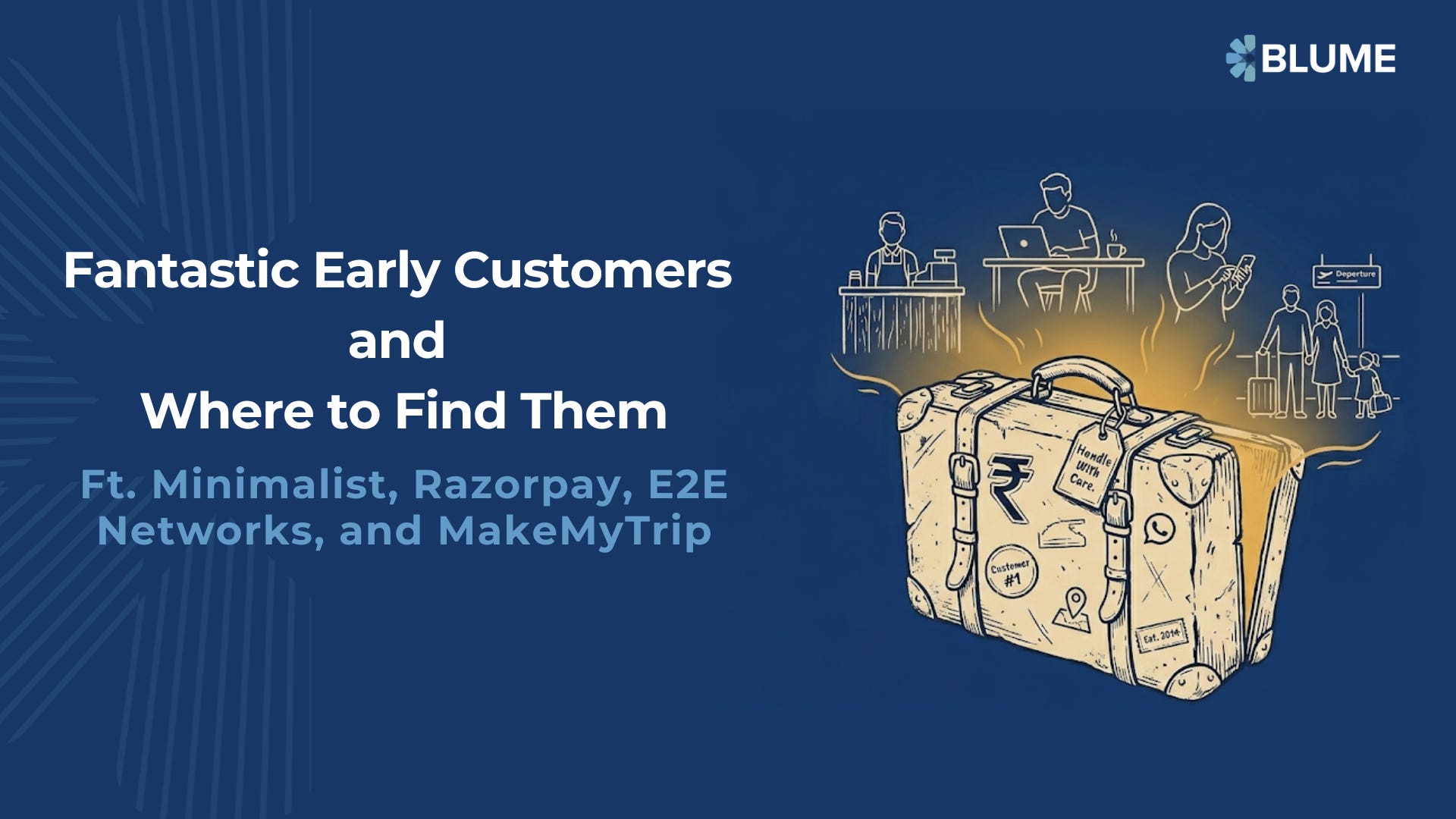
Every blog post on finding early customers gives you the same advice. Talk to users, find your ICP, do things that don’t scale.
All true. None of it tells you what a founder actually does on a Tuesday morning when nobody knows their name and the browser tab is worth zero dollars until somebody pays.
So we went through Season 4 of the Blume Podcast and pulled the moments where 4 founders landed their first paying customer. The actual Tuesday morning hustle version, not the polished one, reserved for conferences.
1. Minimalist: Your ICP is probably wrong. Your customers will tell you.
Mohit and Rahul Yadav launched Minimalist in 2020 aiming at metro Gen-Z, 18-22, higher income.
Data told a different story. Half the orders came from Tier-3 towns. Addresses like “opposite the temple on the fourth gully.” Those customers didn’t want cheaper products. They wanted to know why the pH was 3.6 and not 3.8. They knew this because they handled every DM, email, and comment themselves. 10 AM to midnight. For 2 months.
So Minimalist printed the pH on the bottle, then the molecule name, then the supplier. Every time customers pushed for transparency, the founders said yes.
Within 8 months, Minimalist crossed ₹100 crore in revenue. In 2024, HUL acquired the brand for ₹2,955 crore.
The takeaway: Your first customers will redesign your brand if you let them. The only question is whether you’re close enough to the inbox to notice.
2. Razorpay: Chase the customers everyone else is ignoring.
In 2014, every payment gateway in India served enterprise. Small businesses got 4 years of bank statements, photos of their office, weeks of waiting, and usually a no.
Harshil Mathur and Shashank Kumar went after exactly those customers.
Their first pitch was face-to-face in a Jaipur coworking space: a tiny e-commerce site selling kids’ clothes (still on Razorpay today). From there, the founders went where their customers already hung out. WhatsApp and Facebook startup groups. Bangalore Startups. Mumbai Startups. Pune Startups. The IIT Roorkee alumni group.
Whenever someone posted a payments question, Harshil would reply personally. No pitch. Just proving Razorpay understood how payment systems actually worked.
Within months, he didn’t have to. When someone asked about payment gateways, his customers jumped in before he could: try Razorpay.
The takeaway: Customer love is earned before anyone is watching. Find them where they actually talk. Reply at midnight. Eventually they start selling the product for you.
3. E2E Networks: One marquee customer is a flywheel.
Tarun Dua’s second customer was a wrong number. Someone called looking for a different Tarun. Tarun looked the caller up, phoned him back the next morning, and closed a same-day check.
That customer ran websites in the US. E2E hosted them in India, which made them faster than anything else available. Soon, a competitor of that customer called: why are their sites so fast? The competitor turned out to be CarDekho.
CarDekho was visible. When a well-known product suddenly gets faster, people in the ecosystem ask who did the plumbing. Flipkart called because CarDekho was on E2E. Someone else called because Flipkart was on E2E.
For the first 6-7 years, E2E had zero salespeople. 100%+ growth every year, all word of mouth. 15 unicorns on their servers eventually. Each marquee customer was pulling in the next one.
The takeaway: One marquee customer, served obsessively, is worth more than a sales team. Don’t chase funnel velocity only. Land one logo big enough that the next logo calls you.
4. MakeMyTrip: If the market isn’t ready, stop pushing.
Deep Kalra and Rajesh Magow launched in 2000 with a thesis for 3 markets: inbound, outbound, and domestic. Inbound worked. The other two didn’t. Indians would browse flights on the site, compare prices, close the tab, and call their travel agent.
They could have kept pushing. Burned cash and years doing it.
Instead, they walked away from two-thirds of their vision and bet only on NRIs in the US. Smaller market. But one that already trusted buying online.
Then came the unlock: they paired the website with a call center (1-800-India-10). The site let NRIs research; the phone let them book at a better price, because airlines wouldn’t “bounce” phone-quoted fares the way they did on publicly listed web prices. Every $1,000-1,200 ticket cleared $100 of profit. Conversion climbed. Repeat buyers cut acquisition costs.
The NRI market was resilient too. Weddings, aging parents, emergencies. Those tickets get booked through recessions, through 9/11, through everything.
Every other online travel startup from 2000 vanished. By 2005, MakeMyTrip was the last one standing.
The takeaway: “Keep pushing” is sometimes advice and sometimes how you bleed out. The hardest founder skill is knowing which market deserves your next year, and which one to walk away from.
Read the full stories here: https://blume.vc/commentaries/fantastic-early-customers-and-where-to-find-them
Listen to Season 4 of the Blume Podcast, “Destiny Avenged”: https://blume.vc/podcasts/blume-podcast
Team Blume
Niceee